

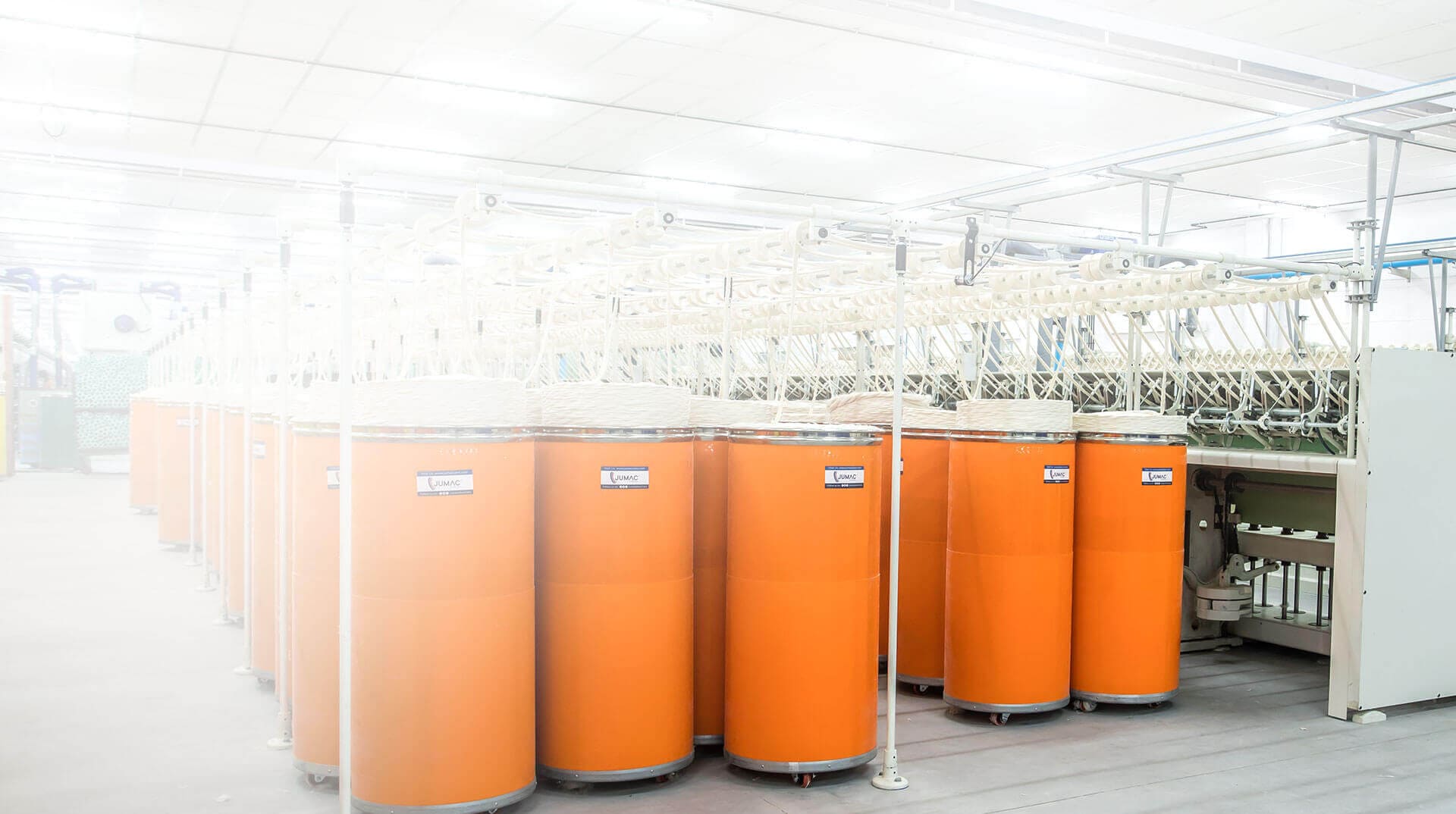





Walk through a spinning mill and the sliver can looks…
How Automation Is Transforming Sliver Management on Mill Floors
The mill floor is already automated.
Just not where you’d expect.
A walk through the automation that’s actually running in spinning mills today, piecing, doffing, winding, logistics, and the one link in the chain that’s still done by hand almost everywhere: moving the can.
Ask most people outside the industry what a “smart spinning mill” looks like and you’ll get a picture of glowing screens and autonomous everything. Walk an actual mill floor and the picture is messier and more interesting: automation has landed hard in a few specific places, is proving itself in a couple more, and hasn’t touched one very physical, very repetitive job at all, moving the can from one machine to the next.
That unevenness isn’t a failure. It’s a map. Automation goes first wherever the return is fastest to prove that a machine that pieces yarn breaks by itself, a winder that never needs a human hand on a package. This piece walks through what’s already live on real shop floors, then looks at the one gap almost everyone in the industry is now staring at.
01 — ALREADY RUNNING
Where the robots already earn their keep
The most mature automation in spinning today sits right at the point of yarn formation, piecing a broken end and pulling off a finished package are both jobs that used to eat operator hours by the thousand, every week, in every shed.
Piecing robots that travel the machine and repair ends-down while the frame keeps running are now common enough that mills report the numbers in aggregate rather than as a novelty. Rieter’s fleet of ROBOspin units across its installed base pieces over a million yarn breaks a week worldwide, which the company estimates removes around 2,000 operator-hours weekly from mills running it, done by machines that used to need a person walking the alley, watching for the flag.
Doffing tells the same story from the rotor side. ROBOdoff automates the job of pulling a full package and starting a fresh one on rotor-spinning frames, unglamorous, physically repetitive work that’s also where package-length inconsistency used to creep in. Gaoyi Delida Textile in China retrofitted thirty of its semi-automated rotor frames with it; Shunyuan Textile did the same on its R36/R37 lines and reported lighter operator load alongside steadier yarn quality.
1M+
Yarn breaks pieced weekly across mills running automated piecing robots
Source: Rieter, ROBOspin fleet data
2,000
Operator-hours saved per week across the same installed base
Source: Rieter
30
Semi-automated rotor frames retrofitted with automatic doffing at one Chinese mill alone
Source: Gaoyi Delida Textile
02 — THE FURTHEST ALONG
Winding is the most automated corner of the mill. And the reason is data, not just motion
If any single department has quietly become “lights-out,” it’s winding. Modern autoconers don’t just splice and wind unattended. They carry sensor-controlled tension checks, auto-calibration, and package doffers that hand off finished cones without a person touching them. The interesting shift isn’t the mechanical part, though; it’s that these machines now sit inside a live data loop that watches quality package by package instead of lot by lot.
That combination is what makes the return-on-investment case easy to point to. MKAS Textile reported 25% lower energy costs after moving to a linked autoconer-and-ring-frame installation, alongside operators who no longer needed to babysit individual machines. Sri Bhagirath Textiles in India runs its compact-spinning frames directly linked to winding, cutting out the intermediate handling step entirely.
What’s easy to miss is how this automation adapts to older buildings, not just new ones. A “MultiLink” configuration, where up to four ring-spinning frames feed a single autoconer, exists specifically because most mills aren’t built on a blank floor plan. Sri Matha Spinning Mills had concrete pillars breaking up its shed and still managed a 2:1 link solution, mixing a direct link with an underfloor one, because the automation was designed to bend around the building rather than the other way round.
The pattern worth noticing: the automation that scales fastest isn’t necessarily the most advanced. It’s the kind that retrofits into a mill exactly as it’s already laid out. That’s a detail that matters a lot more once you get to the can-movement problem below.
03 — BEYOND THE MACHINE
From package to pallet: Automation is leaving the machine and entering logistics
The newest layer of shop-floor automation isn’t about any single machine at all. It’s about the space between machines. Saurer’s Cone-to-Carton system picks up where winding ends, moving finished packages automatically toward palletising and warehouse handling, and its wider Senses mill-management platform ties that movement into the same real-time picture as spinning and winding data.
In a recent industry conversation, Saurer’s global sales leadership made a point worth sitting with: for years, automation in spinning meant a set of separate, disconnected wins — one machine doffing itself here, another splicing itself there, without much of a shared thread between them. The industry is now visibly moving from that fragmented picture toward something closer to a continuous material flow, where the handoffs between machines matter as much as what happens inside each one.
That reframing is exactly why the one handoff still done entirely by hand stands out so sharply.
Blow room — line-fed, largely automated for decades
Carding — autoleveling & self-monitoring standard
Draw frame — autoleveling, auto can-doffing common
Comber & speed frame — mechanised, human-tended
Ring / rotor spinning — piecing & doffing robots (ROBOspin/ROBOdoff)
Illustrative maturity, based on current commercial deployments, not a measured index.
04 — THE GAP
The last manual mile: moving the can itself
Here’s the part of the shop floor that almost nobody photographs for a brochure. Between carding, breaker draw frame, finisher draw frame, comber and speed frame, the material doesn’t fly along a data-connected line. It sits inside a sliver can that a person pushes on a trolley, by hand, dozens of times a shift, in almost every mill on earth.
The industry’s own machine builders say this plainly. Trützschler’s own framing of the problem, in launching its can-transport system, is blunt: in virtually all spinning mills, moving sliver cans is still a manual job, and rising labour costs, a shrinking pool of experienced operators, and tighter quality expectations are turning that fact into a real operating risk rather than just an inconvenience.
That gap is exactly why can transport is the newest frontier in shop-floor automation, and why three of the major machine builders have all launched a version of the same idea within roughly the same window:
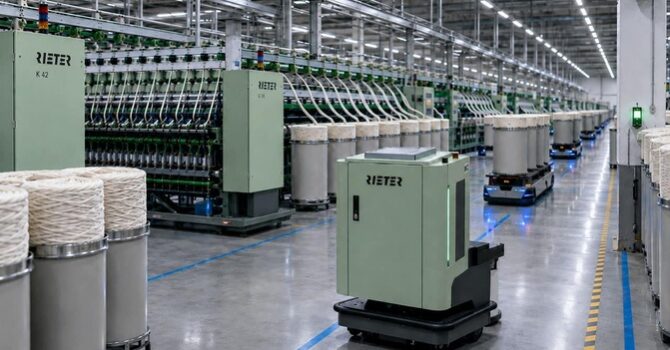
Rieter: SERVOcan. An AGV-based system spanning carding through end-spinning, built around a process-control layer that sequences can movement and cuts waiting time between machines.
Trützschler: T-CAN. Automated guided vehicles paired with software that tracks every can’s movement and places it exactly where it’s needed between cards and draw frames. JINGYI Group in China has already scaled its pilot to more than 120 cards and 240 draw frames.
Saurer: Hunter S1. A “lift-and-transport” AGV that raises the can fully off the floor to avoid wheel jams, built to plug into Saurer’s Senses mill-management ecosystem for real-time tracking.
Why this is harder than it looks: every other automated step so far happens inside a machine’s own footprint. Can transport has to cross open floor, share space with people, and adapt to whatever the building’s columns, aisles and layout already dictate, which is exactly the constraint that made autoconer MultiLink succeed in older sheds. AGV-based systems solve this well in new, purpose-built mills. They’re a much bigger capital and layout decision for the mid-sized, brownfield mills that make up most of the installed base, especially across India.
Rieter SERVOcan · Trützschler T-CAN · Saurer Hunter S1 — same idea, three implementations
05 — WHAT COMES NEXT
Where this is headed
The can has to get smarter before the floor gets automated.
AGV fleets solve can movement well when a mill is built around them from day one. But most spinning capacity in the world wasn’t, and won’t be rebuilt just to fit a fixed AGV corridor. That’s the real opening right now: instead of automating the floor first, instrument the can itself — give every can an identity, a fill-level reading, and a location that the mill’s systems can see, the same way MultiLink let winding automation bend around a shed full of pillars instead of demanding a new one.
A sensor-tagged can that reports what it’s carrying, how full it is, and where it’s sitting turns can movement from a blind, manual guess into a scheduled, trackable job — one that can be automated in stages, on the existing floor, rather than all at once behind a new capital outlay. That’s the direction our own work on IIoT-enabled sliver cans at Jumac is pointed at: making the can the smart, retrofit-friendly starting point for automation that today’s AGV systems assume you’ll build the whole layout around.
It’s a smaller idea than “the autonomous mill,” and that’s precisely why it’s the more useful one for the mill that’s running today, not the one on a five-year capex plan.
Identity — which lot, which line
Fill level — full, part, empty
Location — where on the floor, right now
The takeaway for the shop floor manager, not the trade show.
None of this is a pitch for ripping out a working mill and starting over. The mills getting the most out of automation right now are the ones treating it as a sequence of specific, provable wins: a piecing robot here, a linked autoconer there, a tracked can somewhere down the line, each one paying for itself before the next one gets approved.
The floor is telling a consistent story if you walk it end to end: automation goes first to the places where a machine can own its own job completely. It’s now arriving, more slowly and more unevenly, at the places where material has to cross open space between machines. Can movement is the biggest of those spaces left, and how a mill chooses to close it, full AGV line or smart, staged instrumentation, will shape its shop floor for the next decade, not just the next quarter.
Passionate about transforming the industrial sector of textile and spinning industry with innovative solutions. Director at Jumac Manufacturing, leading spinning cans and accessories manufacturer and exporter from Kolkata, India.